
The following thext is partly machine-translated to save time, and then corrected, adjusted and proofread by myself. Any faults are mine, though I’ll certainly try to blame «the machine» when confronted about any of them. Original Norwegian version is available here: Passer passer? (June 2nd, 2026)
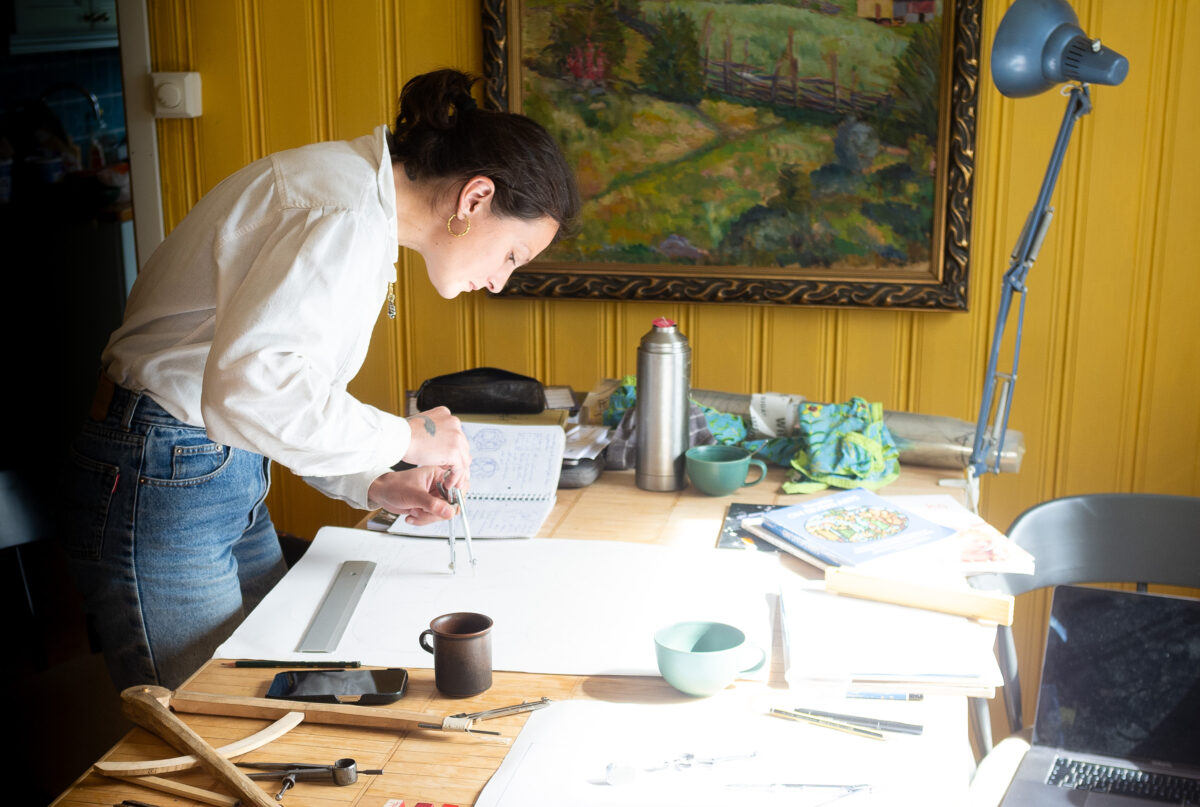
The last two weeks I have had the very pleasant and useful assistance and company from my colleague Lara Domeneghetti, and among the many things we have discussed a lot has circled around dividers and compasses.
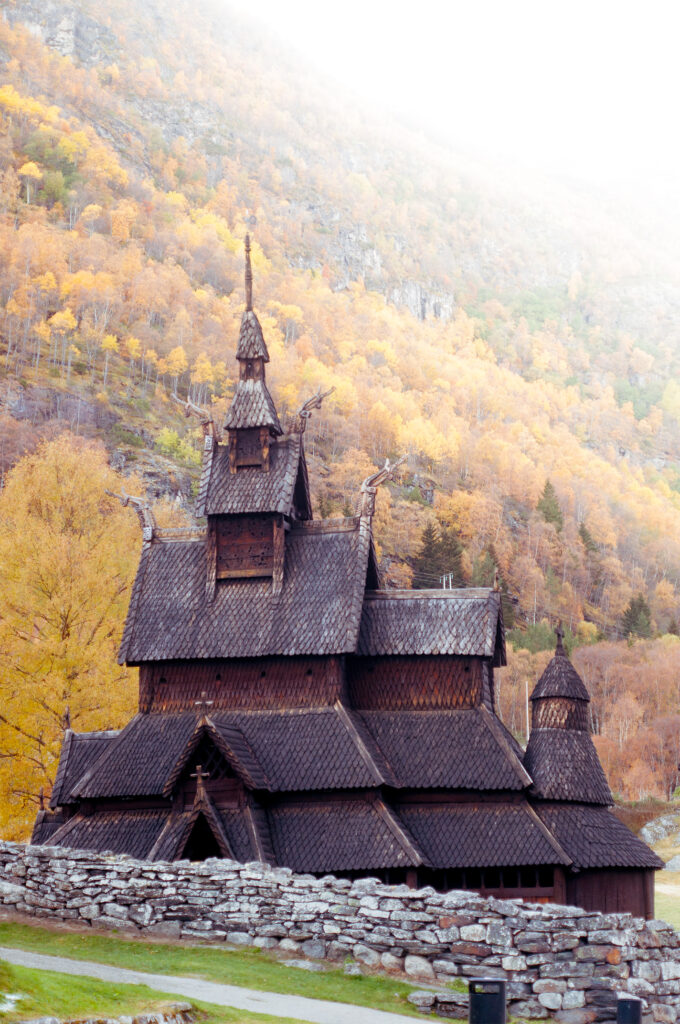
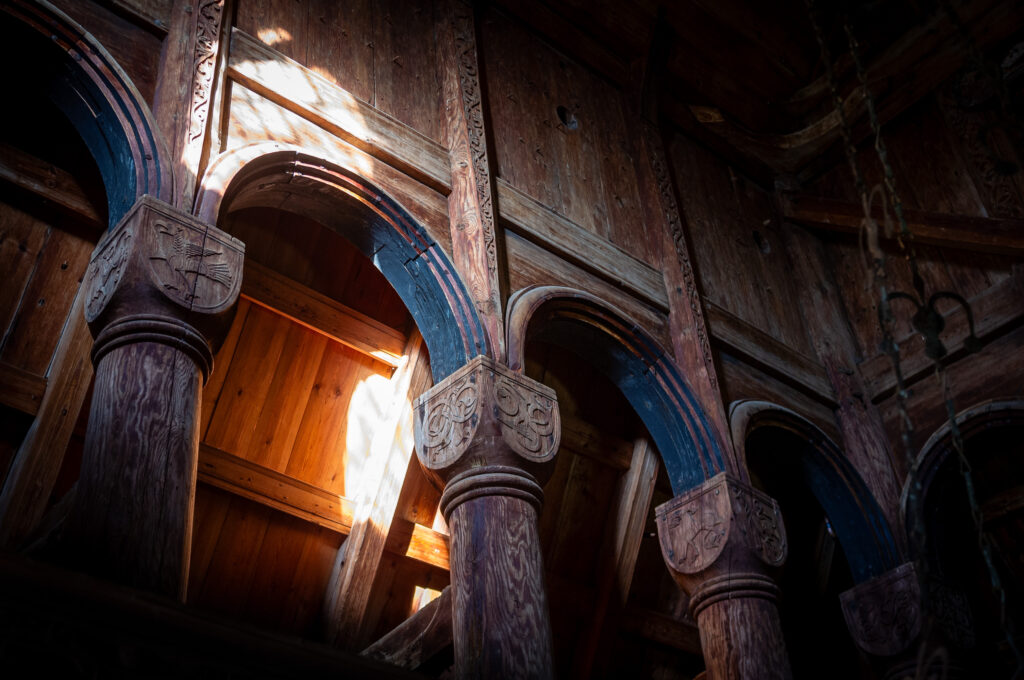
The south side ornaments of the first level of «Takrytteren» (the ridge bell turret of Borgund) has so far eluded interpretation, and a central goal for these two last weeks has been to break some cracks in the shell of this nut. Lara, like me, has spent a good deal of time and effort investigating «artisanal geometry«, and in digging into this topic I believe we have now once again demonstrated (at least to ourselves) that two heads think considerably better than one.

It seems beyond (almost) any doubt that a relatively basic geometry was central to the construction of the stave churches as buildings overall as well as the details of the carvings. Jon Godal does a convincing job of demonstrating as well as documenting the tail end of such a tradition, among other things, in the book ‘Å rekne brøk med han Tykje’1, Jørgen Jensenius conjures up, among other things, the shadow of a similar recipe for stave churches as buildings in ‘Lomen stave church: a mathematical analysis’2, and Erla Hohler carefully nibbles at the edges of a similar problem in portal ornamentation3. Unfortunately(?) Hohler leaves the subject aside without making any particular commitments. For the record, her work is exceedingly thorough and appears very solid — if anything, the reason for this somewhat shallow coverage form her is likely that Hohler considered it to be far too extensive a subject to go into, and her systematic reluctance to indulge in ill-founded speculation. The little (“preliminary”4) that is said about “portal construction” is also very solid, and an invaluable starting point for any future attempt to deconstruct the principles behind (Sogn-Valdresian) stave church portal art. Here and now, however, portal carving is not our focus but rather tower ornamentation.
Almost a year ago, I complained “how well everything (almost) fits”5 and that theme has not really gone quiet since then. At that time, it concerned the ornaments on the north side of this same construction—and at first glance, these hardly differs from the south side. Looking a little closer, it becomes clear that the motifs differ somewhat from each other: on the north side, four lions are depicted in a circle, on the south side, four dragons6. Despite the different animals, the wall panels on the north and south sides appear so similar that Hohler’s suggestion of transferring the design with a stencil7 could almost fit. There, she points to the over 30 different animals that adorn the capitals inside the Urnes stave church that are built up with just a handful of different front and hind parts—that are combined in different ways to create a multitude of different designs. I have probably also (subconsciously) clung to a similarly simple explanation for a year now in the hope that it would also fit here. It would be very nice if I didn’t have to reinvent the wheel to lay out the ornaments for the south side, after having first spent so much time deciphering the north facing wall..
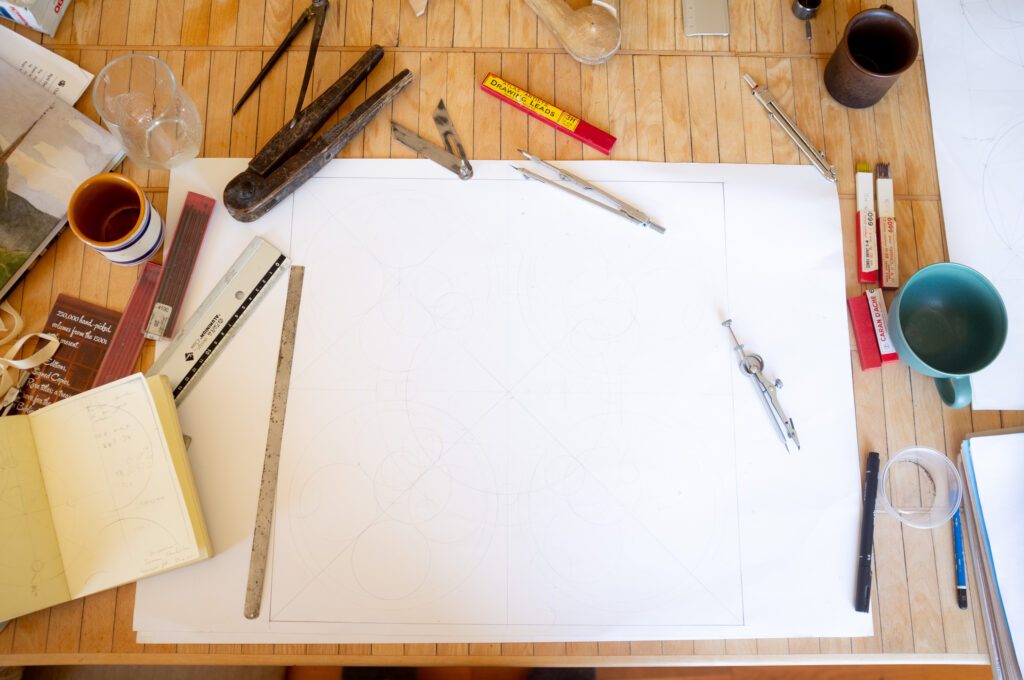
A simple little experiment, however, shows that the north side’s «formula» quickly falls apart if it is applied to the south side’s ornamentation. «The diameter of each of these inner circles is halved, and forms the outline of the front part of each animal»8 I postulated for the north wall’s ornaments. There the resulting proportions fit well, while here on the south side there is no working correspondence between this proposed halving and the actual forms and proportions of the animals. Does this mean that the reconstructed «formula» from the north side was fundamentally wrong? I think it is too early to conclude in any direction about this, but a new round of formula reconstruction was clearly needed for the south side. Perhaps this could also help explain the parts that did not quite fit on the north side:
Most troubling of all, and perhaps an indication that this whole hypothesis of an underlying geometric principle is on shaky ground, is how the “system” often seems to fit only three out of four repetitions.9
I think it is premature to conclude about the research that Lara and I have done into the geometry behind the ornamentation on the south side. But as a taster, I have tried to summarize one plausible “formula” for constructing these motifs. This is certainly not entirely correct, but it may give some idea of how the work may have progressed. It is also formulated in relatively modern quasi-mathematical language—certainly quite different from what was perhaps used at the time. But the action that each point is intended to describe is hopefully much closer to the process as it took place around the 1180s or thereabouts. The “recipe” as presented below is hardly easy to follow in isolation as it is now formulated, and does not contain all the necessary steps. Perhaps the 1180 recipe was also supplemented with visual aids, or perhaps this way of working was so ingrained that the “master of tower ornamentation” had everything in his head. There is every reason to be cautious not to underestimate the role of memory in oral cultures.10
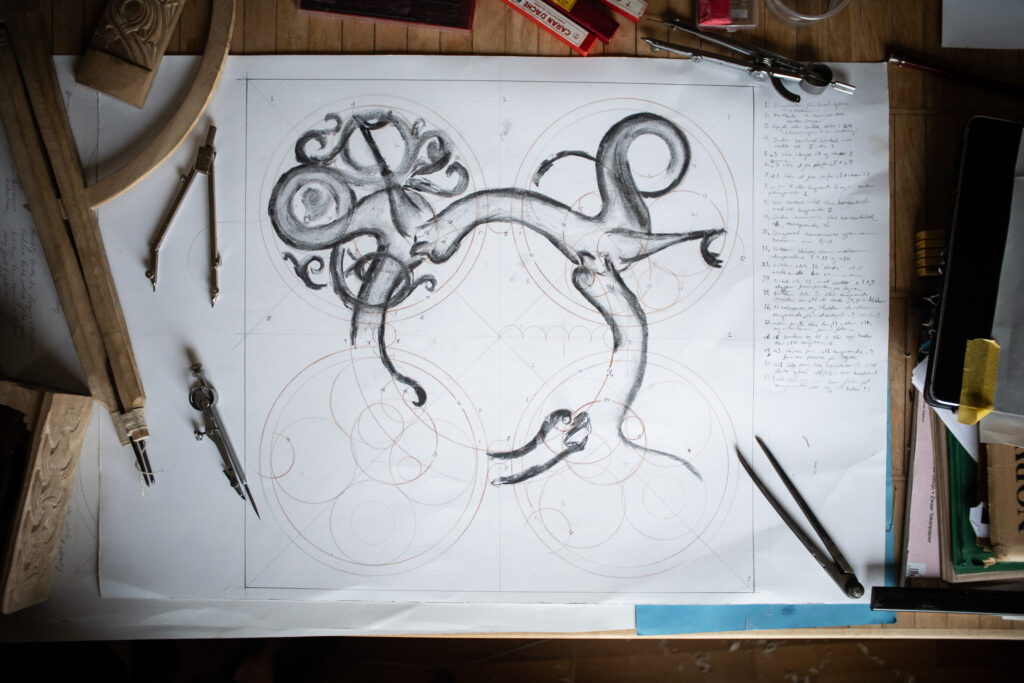
- Diagonals are struck from each corner, finding/indicating the center
- Vertical and horizontal center lines are struck through this center point
- The height (or width) of the entire field is divided into 24. (For example, through three halvings and a third division of the result—though various methods can be imagined.
- From the center, a circle is struck with a radius equal to five times the measure found in 3.
- Where the circle from 4. crosses the horizontal and vertical axes from 2., an auxiliary circle is struck with a diameter equal to (the dimension found in) 3.
- The radius from this auxiliary circle is struck again from where 5. crosses 4.
- The diameter from 3. is struck outward from where 5. crosses the axes 2.
- Four circles with a radius equal to 4. are struck with centers along the diagonals 1. and tangent to the auxiliary circles 5. These four lays out the frames for each of the four medallions (that will later contain the four beasts/dragons)
- An outer auxiliary circle is drawn concentrically with 4., and with a radius from the center to the outer edge of 7. This, and the circle drawn in 4., are both guide lines in the further construction but also auxiliary lines to mark the neck of each of the four animals
- The inner edge of the frame for each of the four medallions is drawn concentrically with 8., and tangentially to 6.
- A diagonal is constructed through the center of (one of) the circle pairs 8./10. /through the center of one of the four medallions
- Circles are inscribed between (tangentially to/touching) the diagonals 1. and 11., and the periphery of 10. The circle 10 is thus filled with four circles as large as they can be while still not overlapping.
- Four such circles with the radius defined in 12. are «sprinkled» into each of the three remaining circles 10.
- Four circles with a radius equal to 12. are drawn with the center where the diagonals 1. intersect the circle 9. These four circles form the front part of each animal.
- Circles with the radius established in 3 are drawn tangentially to the outside of circle 9 and on the left side, inside of 14. These four smaller circles form the concave start of the neck of each animal.
- The diameter of circle 14. is halved, and the «shoulder» of each animal is marked by this circle with the center in the periphery of 9. and tangentially to 14. from the inside.
The same radius is drawn to mark the hind paw of each animal with the center where one of the circles from 12/13. meets 10., directly from where the «shoulder» is placed.*- The radius established in 16. is also used to mark the heads of each animal with the center where the circles 14. intersect the circle 4.
- The diameter from 3. is inscribed in the circles 18. (tangential inside) and tangent to the circle 4.
- The radius from 16. is also struck approximately concentrically with the two outer circles from 12./13. in each of the four frames 8./10.
- The same radius from 16. is struck as the front paw tangent to the inside of 10. and either the neck of each animal or the circle 9.
Especially in point 21. the pattern starts to creak a little in the joints, but the ambiguity in the placement of this circle may simply come from the fact that the construction has not been a pure geometric exercise followed by drawing/marking/painting, but a continuous drawing process where the compass/dividers (compasses?) has continuously supported the drawing of the animals. The contours of bodies, heads, necks and other limbs are not placed strictly geometrically, but are helped into place by the underlying geometry. Where, for example, a neck does not follow the constructed circles exactly, the further subsequent construction is therefore also allowed to follow the actual drawing of the neck and not the geometrically constructed one. This was also the way I ended up working with the «formula» on the north side, and it helped considerably in keeping track of all these (otherwise rather confusing) compass circles.11
This attempt at a “formula” for the south side brought a couple of exciting surprises. At first, the need for a (nearly) completely new formula was a surprise in itself; I had hoped that the one from the north side would fit and that it would serve as a kind of “confirmation” that I was onto something12. Of course, it couldn’t be that simple, but to my great surprise, it now looks like this new “recipe” for the south side can fit (and thus partly explain?) the deviating fourth circle/medallion on the north side. This can almost look like there have been two slightly different “recipes”, and that the person or people who constructed the ornamentation have mixed the “formula” for the south side into the construction of the north side. A closer examination of this may perhaps come a little closer to an answer as to how the construction of this ornamentation may have taken place. The same would probably be true of trying these two “formulas” on the ridge turret parts from Høre Stave Church, but both of these tests will have to wait for another occasion.
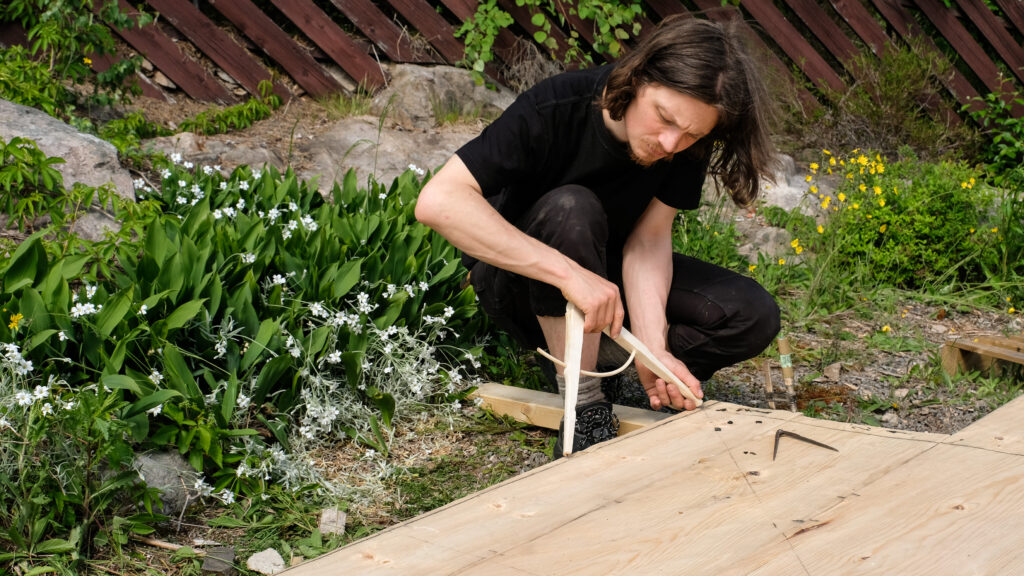
As a small bonus at the end, I am attaching one of the very few medieval iron dividers from Scandinavia that I know of—perhaps a similar one was in use at Borgund about 850 years ago?

*Update: June 4, 2026
I have already through practical testing of this proposed «formula» found details that are not working correctly. Point 17. is such a case, and I already have new ideas for how this point perhaps should have been formulated. But that will be a later post, I will leave this post as it is as a «witness mark» of the process behind investigating this topic. Interestingly the practical testing do indicate that even if details need to be revised the overall framework functions well.
A few feet(notes)
- Godal, 2016, Å rekne brøk med han Tykje ↩︎
- Jensenius, 1988, Lomen stavkirke : en matematisk analyse (Text in both English and Norwegian) ↩︎
- Hohler, 1999-II, p.97 ↩︎
- ibid ↩︎
- Translation from original Norwegian: Treskjærerbloggen, 2025, Akk så godt alt (nesten) passer ↩︎
- Hohler, 1999-I, pp. 120—121, 178 ↩︎
- Hohler, 1999-II, s.95 ↩︎
- Translated from my own: Treskjærerbloggen, 2025, Akk så godt alt (nesten) passer ↩︎
- Translated quote from same ↩︎
- I hesitate to refer to Klug, 2024, p.50; but even if she herself does not necessarily internalize this point completely, it is difficult to avoid that she does a useful job of building up the argument that «Members of oral or preliterate cultures can remember complex facts and relationships to an extent that we can hardly imagine. Therefore, it seems self-evident that master builders could think up complex buildings and keep all the necessary details in mind.» ↩︎
- In excess of 70 circles if I have counted correctly in the «formula» as I describe it here, depending on how one counts. The number in isolation is also completely beside the point. ↩︎
- «the south side of the ridge turret can also be a useful test» translated from the last paragraph of Akk så godt alt (nesten) passer, 2025 ↩︎
Literature
Fairly relevant to this post is my earlier post on the Treskjærebloggen with title translating to «Alas, everything (almost) fits»: Akk så godt alt (nesten) passer (August 25, 2025)
Godal, Jon Bojer (2016) Å rekne brøk med han Tykje. J.B. Godal oog Steinar Moldal, Valsøybotn. ISBN: 978-82-690486-0-5
Hohler, Erla (1999) Norwegian stave church sculpture volume I & II. Universitetsforlaget, Oslo
Jensenius, Jørgen H. (1988) Lomen stavkirke : en matematisk analyse = The Stave church of Lomen : a mathematical analysis. Alvheim & Eide, Øvre Ervik. ISBN: 82-90359-40-3
Klug, Sonja Ulrike (2024) Passion for Compasses: Medieval Master Builders and their Cathedral Building Plans. Kluges Verlag, Bad Honnef. ISBN: 978-3-910321-20-5
All photos where nothing else is stated are by Jon Anders Fløistad/ Norsk Håndverksinstitutt


